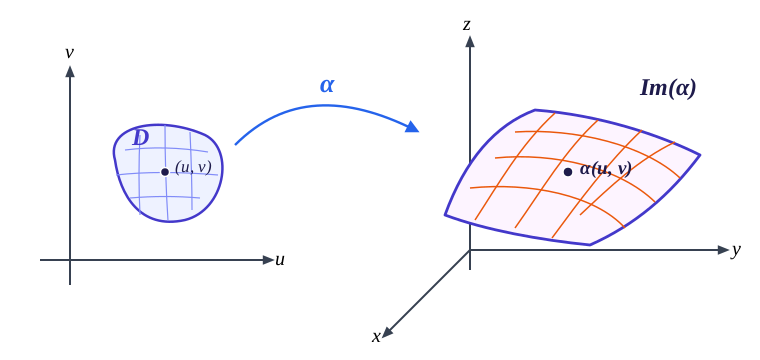
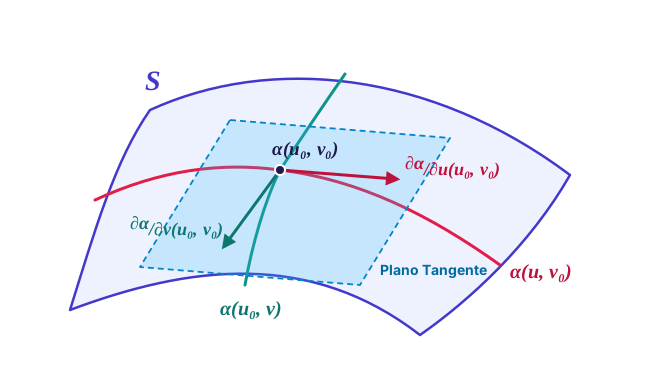
Definição 3.2.13.
Seja \(\alpha: D \subseteq \mathbb{R}^2 \to \mathbb{R}^3\) uma superfície parametrizada suave e injetiva com imagem \(S\text{,}\) e seja \(f(x,y,z)\) uma função contínua definida sobre \(S\text{.}\) A integral de superfície de \(f\) sobre \(S\) é dada por:
\begin{equation*}
\iint_{S} f(x,y,z) \, dS = \iint_{D} f(\alpha(u,v)) \left\|\frac{\partial \alpha}{\partial u} \times \frac{\partial \alpha}{\partial v}\right\| dA
\end{equation*}
Exemplo 3.2.16.
Calcule \(\iint_{S} z \, dS\text{,}\) onde \(S\) é a porção do cone \(z = \sqrt{x^2+y^2}\) situada abaixo do paraboloide \(4z = x^2 + y^2 + 3\text{.}\)
Solução.
Determinamos a interseção entre o cone \(z^2 = x^2+y^2\) e o paraboloide \(4z = (x^2+y^2) + 3\text{:}\)
\begin{equation*}
z^2 - 4z + 3 = 0 \implies z = 1 \quad \text{ou} \quad z = 3
\end{equation*}
A projeção de \(S\) sobre o plano \(xy\) é o anel circular delimitado por \(x^2+y^2 = 1\) e \(x^2+y^2 = 9\text{.}\)
Parametrizando por \(\alpha(x,y) = (x, y, \sqrt{x^2+y^2})\text{,}\) temos \(\|\alpha_x \times \alpha_y\| = \sqrt{2}\text{.}\) Em coordenadas polares, a região é descrita por \(1 \le r \le 3\) e \(0 \le \theta \le 2\pi\text{:}\)
\begin{align*}
\iint_{S} z \, dS \amp = \iint_{D} \sqrt{x^2+y^2} \sqrt{2} \, dA = \sqrt{2} \int_{0}^{2\pi} \int_{1}^{3} r \cdot r \, dr \, d\theta\\
\amp = \sqrt{2} (2\pi) \left.\frac{r^3}{3}\right|_{1}^{3} = 2\sqrt{2}\pi \left(\frac{27 - 1}{3}\right) = \frac{52\sqrt{2}\pi}{3}
\end{align*}
Se \(S\) é uma superfície suave por partes formada pela união \(S = S_1 \cup S_2 \cup \dots \cup S_n\text{,}\) interceptando-se apenas em suas fronteiras, a integral é dada por:
\begin{equation*}
\iint_{S} f(x,y,z) \, dS = \sum_{i=1}^{n} \iint_{S_i} f(x,y,z) \, dS
\end{equation*}
Exemplo 3.2.17.
Calcule \(\iint_{S} z \, dS\text{,}\) onde \(S\) é a superfície fechada composta pelo cilindro lateral \(S_1: x^2 + y^2 = 1\text{,}\) pelo fundo \(S_2: x^2 + y^2 \le 1\) em \(z = 0\text{,}\) e pelo topo \(S_3\) no plano \(z = 1 + x\text{.}\)
Solução.
Calculamos a integral em cada uma das três superfícies:
Superfície lateral \(S_1\text{:}\) com parâmetros \(\theta\) e \(z\text{,}\) \(x = \cos\theta\text{,}\) \(y = \sin\theta\text{,}\) \(z = z\text{,}\) onde \(0 \le \theta \le 2\pi\) e \(0 \le z \le 1 + \cos\theta\text{.}\) O elemento de área é \(\|r_\theta \times r_z\| = 1\text{.}\)
\begin{align*}
\iint_{S_1} z \, dS \amp = \int_{0}^{2\pi} \int_{0}^{1+\cos\theta} z \, dz \, d\theta = \frac{1}{2} \int_{0}^{2\pi} (1 + \cos\theta)^2 \, d\theta\\
\amp = \frac{1}{2} \int_{0}^{2\pi} \left(1 + 2\cos\theta + \frac{1+\cos 2\theta}{2}\right) d\theta = \frac{3\pi}{2}
\end{align*}
Fundo \(S_2\text{:}\) sobre o plano \(z = 0\text{,}\) temos \(f(x,y,0) = 0\text{,}\) logo:
\begin{equation*}
\iint_{S_2} z \, dS = \iint_{S_2} 0 \, dS = 0
\end{equation*}
Topo \(S_3\text{:}\) faz parte do plano \(z = 1+x\) sobre o disco unitário \(D: x^2+y^2 \le 1\text{.}\) O elemento de área é \(\sqrt{1 + z_x^2 + z_y^2} = \sqrt{1 + 1^2 + 0} = \sqrt{2}\text{.}\) Em coordenadas polares:
\begin{align*}
\iint_{S_3} z \, dS \amp = \iint_{D} (1+x)\sqrt{2} \, dA = \sqrt{2} \int_{0}^{2\pi} \int_{0}^{1} (1 + r\cos\theta) r \, dr \, d\theta\\
\amp = \sqrt{2} \int_{0}^{2\pi} \left(\frac{1}{2} + \frac{\cos\theta}{3}\right) d\theta = \sqrt{2}\pi
\end{align*}
Somando as três contribuições:
\begin{equation*}
\iint_{S} z \, dS = \frac{3\pi}{2} + 0 + \sqrt{2}\pi = \left(\frac{3}{2} + \sqrt{2}\right)\pi
\end{equation*}