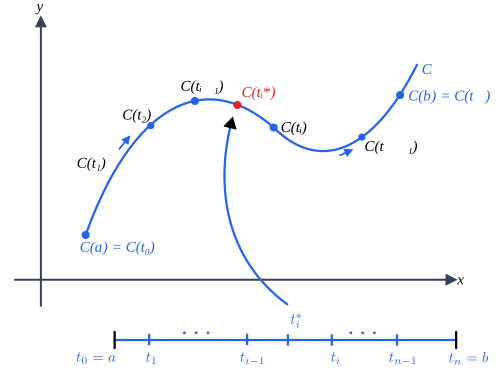
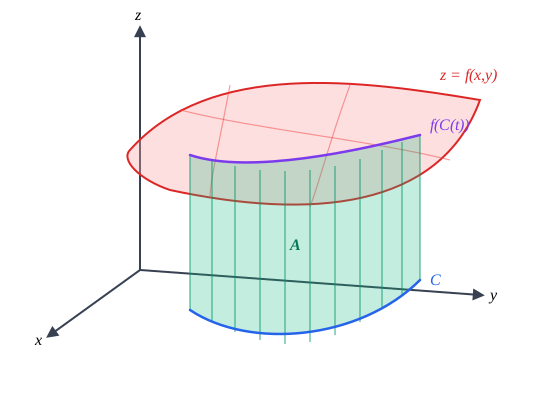
A curva \(C\) pode ser parametrizada por \(C(t) = (t, t^2)\text{,}\) onde \(-1 \le t \le 1\text{.}\)
Daí, \(C'(t) = (1, 2t)\text{,}\) e portanto \(||C'(t)|| = \sqrt{1^2 + (2t)^2} = \sqrt{1 + 4t^2}\text{.}\) Logo:
\begin{align*}
\int_C f(x,y) \, ds \amp = \int_{-1}^{1} f(t, t^2) ||C'(t)|| \, dt\\
\amp = \int_{-1}^{1} (t + t^2) \sqrt{1 + 4t^2} \, dt\\
\amp = \underbrace{\int_{-1}^{1} t \sqrt{1 + 4t^2} \, dt}_{(1)} + \underbrace{\int_{-1}^{1} t^2 \sqrt{1 + 4t^2} \, dt}_{(2)}
\end{align*}
Cálculo da Integral (1): Fazendo a substituição de variável \(u = 1 + 4t^2 \implies du = 8t \, dt \implies t \, dt = \frac{du}{8}\text{.}\) Para \(t = -1 \implies u = 5\) e para \(t = 1 \implies u = 5\text{.}\) Logo:
\begin{equation*}
\int_{-1}^{1} t \sqrt{1 + 4t^2} \, dt = \int_{5}^{5} \sqrt{u} \, \frac{du}{8} = 0
\end{equation*}
(Observação: a função \(g(t) = t\sqrt{1+4t^2}\) é uma função ímpar em um intervalo simétrico \([-1,1]\)).
Cálculo da Integral (2): Utilizamos a substituição trigonométrica \(2t = \tan \theta \implies t = \frac{1}{2} \tan \theta\) e \(dt = \frac{1}{2} \sec^2 \theta \, d\theta\text{.}\) Temos \(t^2 = \frac{1}{4} \tan^2 \theta\) e \(\sqrt{1+4t^2} = \sqrt{1+\tan^2 \theta} = \sec \theta\text{.}\)
\begin{align*}
\int t^2 \sqrt{1 + 4t^2} \, dt \amp = \int \frac{1}{4} \tan^2 \theta \cdot \sec \theta \cdot \frac{1}{2} \sec^2 \theta \, d\theta\\
\amp = \frac{1}{8} \int \tan^2 \theta \sec^3 \theta \, d\theta = \frac{1}{8} \int (\sec^2 \theta - 1) \sec^3 \theta \, d\theta\\
\amp = \frac{1}{8} \left( \int \sec^5 \theta \, d\theta - \int \sec^3 \theta \, d\theta \right)
\end{align*}
Para resolver \(\int \sec^5 \theta \, d\theta\text{,}\) integramos por partes: Escolhemos \(u = \sec^3 \theta \implies du = 3 \sec^3 \theta \tan \theta \, d\theta\) e \(dv = \sec^2 \theta \, d\theta \implies v = \tan \theta\text{.}\)
\begin{align*}
\int \sec^5 \theta \, d\theta \amp = \tan \theta \sec^3 \theta - 3 \int \tan^2 \theta \sec^3 \theta \, d\theta\\
\amp = \tan \theta \sec^3 \theta - 3 \int (\sec^2 \theta - 1) \sec^3 \theta \, d\theta\\
\amp = \tan \theta \sec^3 \theta - 3 \int \sec^5 \theta \, d\theta + 3 \int \sec^3 \theta \, d\theta
\end{align*}
Isolando \(\int \sec^5 \theta \, d\theta\text{:}\)
\begin{align*}
4 \int \sec^5 \theta \, d\theta =\amp~ \tan \theta \sec^3 \theta + 3 \int \sec^3 \theta \, d\theta\\
\int \sec^5 \theta \, d\theta =\amp~ \frac{\tan \theta \sec^3 \theta}{4} + \frac{3}{4} \int \sec^3 \theta \, d\theta
\end{align*}
Substituindo de volta na expressão:
\begin{align*}
\frac{1}{8} \int \sec^5 \theta \, d\theta \amp - \frac{1}{8}\int \sec^3 \theta \, d\theta =\\
\amp = \frac{1}{8} \left( \frac{\tan \theta \sec^3 \theta}{4} + \frac{3}{4} \int \sec^3 \theta \, d\theta - \int \sec^3 \theta \, d\theta \right)\\
\amp = \frac{1}{8} \left( \frac{\tan \theta \sec^3 \theta}{4} - \frac{1}{4} \int \sec^3 \theta \, d\theta \right)
\end{align*}
Como \(\int \sec^3 \theta \, d\theta = \frac{1}{2} (\sec \theta \tan \theta + \ln|\sec \theta + \tan \theta|)\text{,}\) e sabendo que \(\tan \theta = 2t\) e \(\sec \theta = \sqrt{1+4t^2}\text{:}\)
\begin{align*}
\int \amp t^2 \sqrt{1 + 4t^2} \, dt = \\
\amp =\frac{1}{8} \left( \frac{2t(\sqrt{1+4t^2})^3}{4} - \frac{1}{2}(2t)\sqrt{1+4t^2} - \frac{1}{2} \ln|\sqrt{1+4t^2} + 2t| \right) + C
\end{align*}
Avaliando no intervalo \([-1, 1]\text{:}\)
\begin{align*}
\int_{-1}^{1} t^2 \sqrt{1 + 4t^2} \, dt =\amp \frac{1}{8} \left( \frac{2(\sqrt{5})^3}{4} - \frac{2\sqrt{5}}{2} - \frac{\ln(\sqrt{5}+2)}{2} \right)\\
\amp - \frac{1}{8} \left( \frac{-2(\sqrt{5})^3}{4} + \frac{2\sqrt{5}}{2} - \frac{\ln(\sqrt{5}-2)}{2} \right)
\end{align*}
Simplificando os termos, obtemos o valor final da integral.